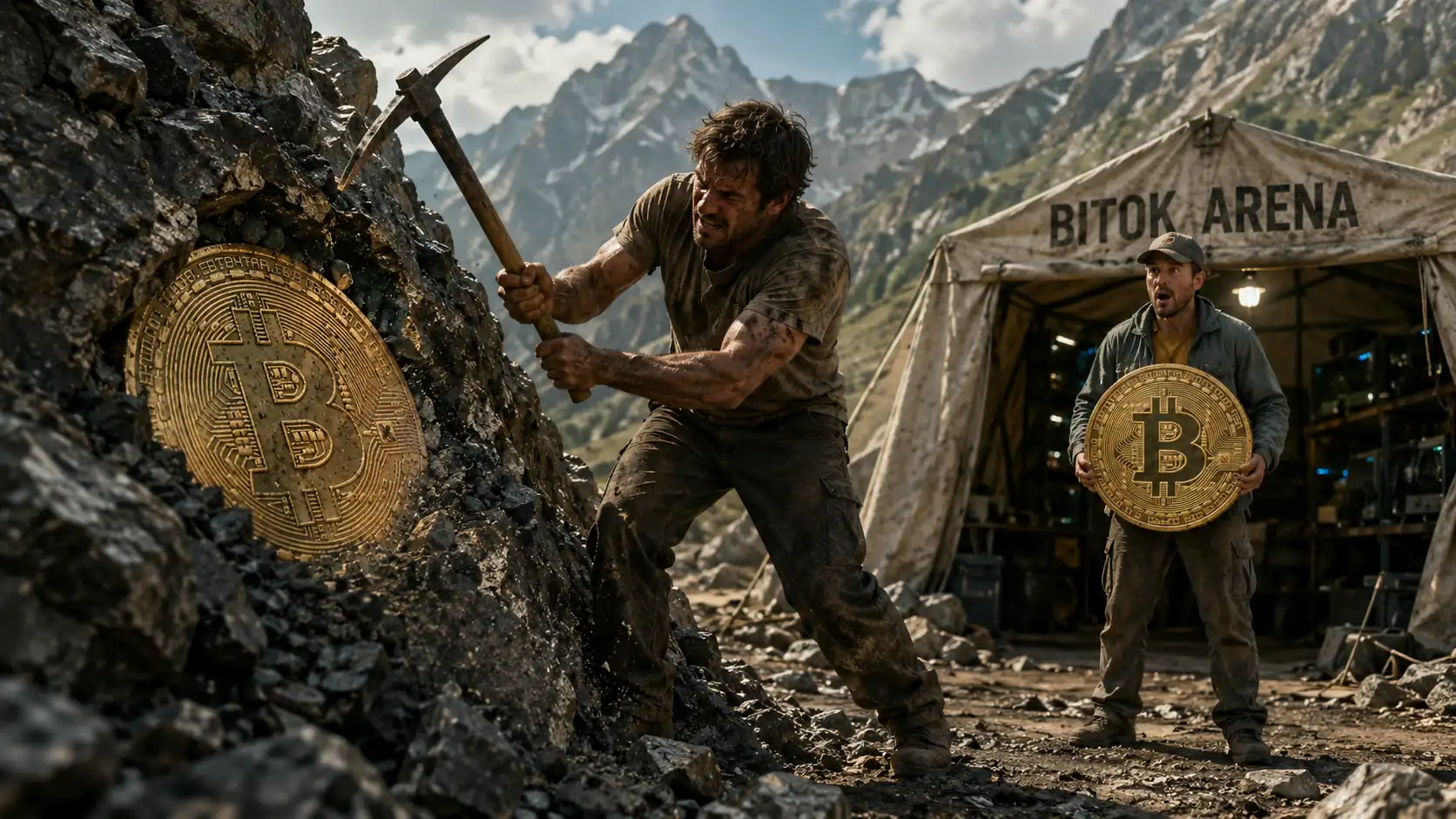
Mining promised something simple.
Contribute computing power to the Bitcoin network. Earn Bitcoin in return. No middleman. No permission required. Just hardware, electricity, and math.
For a few years, that promise held. A personal computer could participate meaningfully in the network. The early miners were individuals, not institutions.
That era ended a long time ago.
On Bitok Arena, you earn Bitcoin without mining, without trading, and without any infrastructure beyond a Bitcoin wallet. You send BTC from your address to the competition's master wallet. Your address ranks in the live leaderboard. The top three positions when the round closes each receive a share of the prize pool — paid in Bitcoin, directly on-chain, to those addresses.
Reaching one of these three positions doesn't require joining a pool, accepting an operator's fee structure, or signing up for anything at all — the closest thing to registration is sending a transaction. That's closer to the "no middleman" promise mining made in its early years than mining itself can offer today. The promise moved. This is where it landed.
What Mining Actually Became
The Bitcoin network's difficulty adjustment is one of its most important properties. Every two weeks, it recalibrates based on how much total computing power is pointed at the network. More miners means harder blocks. Harder blocks means the same Bitcoin output spread across more hardware.
The people who responded to difficulty increases with more machines are now running warehouses. Not homes. Warehouses — with industrial power contracts, cooling infrastructure, and ASICs purpose-built for nothing except Bitcoin hashing. They are not hobbyists. They are operations.
Earning Bitcoin from mining at home means competing against those operations. A consumer GPU earns fractions of what industrial hardware earns per kilowatt-hour, and electricity costs the same regardless of who's paying the bill.
This doesn't make mining wrong. It makes it inaccessible for most people. The barrier isn't technical knowledge — it's capital. The kind that buys racks of specialized hardware and negotiates bulk electricity rates by the megawatt.
The dream of earning Bitcoin by participating hasn't gone anywhere. The infrastructure required to do it through mining just left most people behind.
What the Competition Model Offers Instead
Bitok Arena is built on a mechanism for earning Bitcoin that doesn't require hardware, doesn't scale with processing power, and doesn't get harder as more participants join.
The leaderboard ranks addresses by one thing: total BTC committed during the round. There is no computational arms race. A participant with a phone wallet competes on exactly the same terms as anyone else watching the same leaderboard at the same time.
The barrier to participating is identical regardless of who you are: a Bitcoin wallet with BTC in it, and the decision of when and how much to commit. No specialized equipment. No energy consumption beyond the device you already own. No infrastructure that depreciates the moment a newer generation of hardware ships.
You don't need a machine to earn Bitcoin. You need a position. And positions are available every day, to every address, on the same terms.
Mining left most people behind — the infrastructure costs, the electricity contracts, the hardware that became obsolete in a cycle. Bitok Arena requires none of it. Your self-custody wallet and existing BTC are the only infrastructure needed. Send BTC to the Bitok Arena master wallet and earn Bitcoin through competition, not processing power.